vCPU vs core: what a cloud provider is actually selling you
Two providers quoting four vCPUs may be selling quite different amounts of compute. Here is what the unit means and how to compare honestly.
Two providers both advertise four vCPUs at similar prices. One consistently completes your job in half the time. Nothing is wrong with either of them, and the specification was never comparable in the first place, because vCPU vs core is not a like for like unit.
What a vCPU usually is
On most cloud platforms, a vCPU maps to one hardware thread rather than one physical core. Modern processors run two threads per core, so a four vCPU instance is typically two physical cores with simultaneous multithreading enabled.
That is not deceptive, it is just a unit that needs stating. Two threads on one core deliver more total throughput than one thread, but nothing close to two full cores. For parallel workloads the gain is real; for a single threaded process it is nothing at all.
The units that differ
Oracle Cloud quotes OCPUs. An OCPU is a physical core with hyperthreading, so one OCPU is roughly two vCPUs elsewhere. Comparing an Oracle price per OCPU against an AWS price per vCPU without normalising produces an answer that is wrong by a factor of two, in Oracle’s favour.
Some providers allocate dedicated physical cores on their higher tiers and share threads on their entry tiers, without always changing the word they use.
Before comparing anything, establish what unit each side is quoting.
Shared against dedicated
The larger practical difference is not thread counting, it is whether the allocation is guaranteed.
Shared or burstable. You receive a baseline share of a core and can use more when the host is quiet. Some providers formalise this with a credit system: the instance accrues credits while idle and spends them under load, throttling when they run out. Excellent value for spiky, low average workloads. Unpredictable for anything with a sustained floor.
Dedicated. The threads or cores are yours. No noisy neighbour effects, consistent latency, higher price. This is what you move to when the variance rather than the average becomes the problem.
The symptom that tells you to move is not a slow average. It is a response time distribution with a long tail: most requests fast, some inexplicably slow, no pattern in the application logs.
Clock speed and generation still matter
A vCPU on a current generation processor does meaningfully more work per second than one on a five year old part. Providers frequently offer both at different prices, and the newer generation is often cheaper per unit of actual work despite the higher hourly rate.
Architecture matters too. Arm based instances from all the major providers generally offer better price for performance where the software runs natively, which today covers most Linux workloads, containers built for multiple architectures and standard runtimes.
vCPU vs core: how to compare honestly
- Normalise the unit. Convert everything to threads or to physical cores before looking at price.
- Check shared against dedicated. These are different products and should not be compared on price alone.
- Note the processor generation and architecture. Both change the amount of work per unit.
- Benchmark your own workload. Synthetic scores are a weak proxy. Run the actual job for an hour on each candidate; it costs almost nothing and settles the argument.
- Measure the tail, not the mean. The ninety ninth percentile is what your users experience.
Where the quota comes in
Confusingly, the same word governs how much you are allowed to run. Cloud providers cap concurrent capacity in vCPU terms per account or project and per region, and those limits start low on new accounts. A machine you can afford is not necessarily a machine you can launch. The mechanics are in AWS vCPU quotas explained, and the same pattern applies on Azure and Google Cloud.
For the naming schemes that encode all of this, see EC2 instance families, Azure VM series decoded and Compute Engine machine types.
Common questions
Is one vCPU the same as one physical core?
Usually not. On most providers a vCPU is a hardware thread, so two vCPUs share one physical core. Some providers and some plan tiers allocate whole cores instead.
What is an OCPU on Oracle Cloud?
An OCPU is a physical core with hyperthreading enabled, which corresponds to roughly two vCPUs elsewhere. Comparing an OCPU price against a vCPU price without normalising will be wrong by a factor of two.
Does a shared vCPU mean my server is slow?
Not inherently. Shared allocation performs well when neighbours are quiet and degrades when they are not. The problem is variance rather than average speed.

AccountMarket Editorial
Written and maintained by the team behind accountmarket.org. We publish practical notes on the cloud platforms we work with every day, and we update articles when the platforms or our catalogue change.
Accounts covered in this article
Live options and pricing from the catalogue.
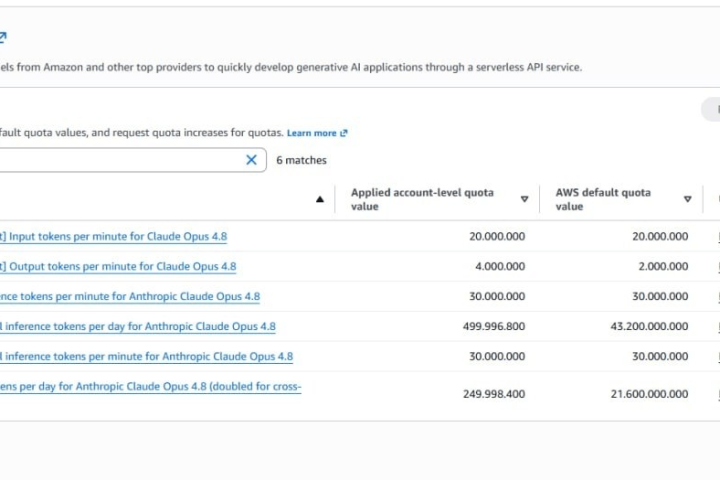
Buy Amazon AWS Account
Amazon Web Services accounts with preloaded credits and root access, including Bedrock ready options across twenty plan tiers.
From $20.00
Buy Google Cloud Account
Google Cloud Platform accounts with preloaded credits and console access, sized for everything from a first project to production workloads.
From $60.00
Buy Oracle Cloud Account
Oracle Cloud Infrastructure accounts with credits and console access, including where Arm capacity is genuinely constrained.
From $45.00
Keep reading

AWS
Amazon Bedrock explained: model access, quotas and what RPM really limits
Bedrock throughput is governed by requests and tokens per minute, per model and per region. Here is how those limits interact, and why two accounts with the same plan behave differently.

Email and Workspace
Outbound port 25 on cloud servers, and what providers allow
Almost every cloud provider blocks outbound SMTP on new accounts. Here is why, what each one does about it, and how to decide whether you need it lifted at all.

AWS
AWS vCPU quotas explained, and why your instance launch fails
VcpuLimitExceeded is the most common wall a new AWS account hits. Here is how the quota system is grouped, how to read your real limit, and how to get it raised.