Amazon Bedrock explained: model access, quotas and what RPM really limits
Bedrock throughput is governed by requests and tokens per minute, per model and per region. Here is how those limits interact, and why two accounts with the same plan behave differently.
Amazon Bedrock is a managed API in front of a set of foundation models. You do not provision servers, you do not manage weights, and you do not choose an instance type. What you do manage, and what decides whether your application works under load, is throughput.
That throughput is expressed in two numbers per model per region, and understanding how they interact explains most of the confusion around Bedrock capacity.
Model access comes before quota
A fresh account with Bedrock enabled cannot call anything yet. Each model has to be enabled in the Model access screen of the region you intend to use, and several require you to accept the model provider’s end user licence before the request is granted.
This trips people up because the failure looks like a permissions problem. You have the IAM policy, the SDK is configured, the region is right, and the call still fails. Nine times out of ten the model simply has not been enabled in that region.
Access is also regional. Enabling a model in us-east-1 does nothing for eu-west-1, and model availability itself differs by region. Some models launch in a handful of regions and expand later, so the region you pick constrains the menu.
RPM and TPM, and which one you hit first
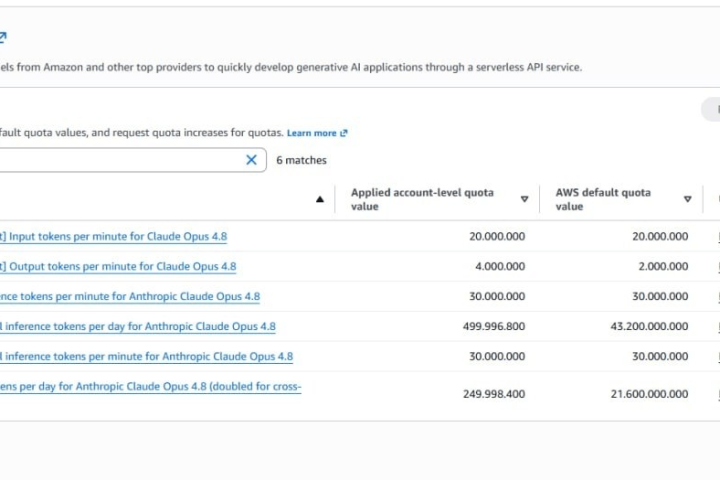
Bedrock applies two on demand quotas to each model:
- Requests per minute (RPM). How many
InvokeModelorConversecalls you may make in a rolling minute. - Tokens per minute (TPM). The total tokens processed in that minute, input and output combined.
Whichever limit you reach first is the one that throttles you, and which one that is depends entirely on your prompt shape. A chat interface sending short turns will run out of requests long before tokens. A document summariser pushing 40,000 token contexts will exhaust TPM while barely registering on RPM.
This is why a headline RPM figure alone is a poor description of capacity. If your average request is large, do the arithmetic: multiply expected tokens per request by target requests per minute and check the result against the TPM number.
Cross region inference
Inference profiles let a single call be routed to one of several regions in a geography. The practical effect is that your requests draw on the quota pools of more than one region, which raises the throughput ceiling without any change to your code beyond using the profile identifier instead of the plain model identifier.
There are trade offs. Requests may be served outside the region you nominated, which matters if you have data residency commitments, and latency varies with where a given request lands. For most applications the throughput gain is worth it; for regulated workloads, read the routing map first.
On demand against provisioned throughput
On demand billing charges per token with no commitment, subject to the shared quotas above. Provisioned throughput reserves dedicated capacity for a model, billed hourly, with a commitment term for the better rates.
Provisioned capacity makes sense when you have a steady, predictable, high volume workload and throttling is unacceptable. It is poor value for spiky or exploratory work, because you pay for the reservation whether you use it or not. Most teams start on demand, measure for a month, and only then decide whether a reservation pays for itself.
What varies between accounts
Two accounts with identical IAM setups can behave very differently on Bedrock, for reasons that have nothing to do with the code:
- Different models enabled, or enabled in different regions.
- Different applied RPM and TPM values, since quota increases are granted per account.
- Different region availability, if one account is operating where a model has not launched.
- Whether cross region inference profiles are in use.
When comparing accounts, the useful questions are which models, in which regions, at what RPM and TPM. A single number without that context does not tell you much.
Designing around the limits
A few habits keep Bedrock workloads stable:
- Measure tokens, not requests. Log input and output tokens per call from day one. You cannot reason about TPM without that data.
- Trim context aggressively. Token limits reward shorter prompts twice over: lower cost and higher effective request throughput.
- Separate interactive and batch traffic. Give user facing requests priority and let background jobs absorb the throttling.
- Fail over between models. If a smaller model is acceptable for some requests, routing overflow to it keeps the service responsive during spikes.
- Watch the CloudWatch metrics. Bedrock publishes invocation and throttle counts. Alarm on throttles before users report slowness.
Where Amazon Bedrock sits next to the rest of AWS
Bedrock capacity is entirely independent of EC2 capacity. An account with a high standard vCPU quota may have no model access at all, and an account with generous Bedrock throughput may not be able to launch a mid sized instance. If you need both, check both. The mechanics of the compute side are covered in AWS vCPU quotas explained, and the broader account picture in AWS account types explained.
If you are weighing platforms for inference work rather than AWS specifically, AWS vs Google Cloud covers how the two approach managed model APIs differently.
Common questions
What is the difference between RPM and TPM on Bedrock?
RPM caps how many requests you may send per minute. TPM caps the total tokens processed per minute across those requests. A workload with long prompts can exhaust the token limit long before it reaches the request limit.
Is Bedrock model access automatic?
No. Access is requested per model within each region, and some models require you to accept the provider's terms first. Until access is granted, calls to that model fail regardless of your quota.
Does a high Bedrock quota affect EC2 capacity?
No. Bedrock throughput and EC2 vCPU quotas are unrelated. An account can have generous model throughput and almost no compute headroom, or the reverse.

AccountMarket Editorial
Written and maintained by the team behind accountmarket.org. We publish practical notes on the cloud platforms we work with every day, and we update articles when the platforms or our catalogue change.
Accounts covered in this article
Live options and pricing from the catalogue.
Buy Amazon AWS Account
Amazon Web Services accounts with preloaded credits and root access, including Bedrock ready options across twenty plan tiers.
From $20.00
Keep reading

AWS
AWS account types explained: free tier, pay as you go and credit backed accounts
An AWS account is a billing and isolation boundary, not just a login. Here is what actually differs between a fresh account, an aged one and a credit backed one, and how to pick.

Cloud Comparisons
AWS vs Azure: how to actually choose between them
For most organisations this is not a technical decision. Here is what genuinely differs, what does not, and the three questions that usually settle it.
Cloud Comparisons
AWS vs Google Cloud: catalogue depth against a cleaner pricing model
These two differ more than AWS and Azure do. The billing model, the networking design and the data tooling all point in different directions.